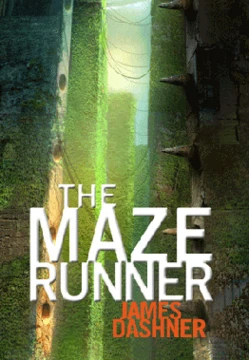
The Maze
Tall walls, shifting paths, and something huge skittering in the dark—welcome to the Maze.

The Maze is the vast, ever-shifting labyrinth at the heart of the Maze Runner saga—a towering stone maze set within a walled valley, where a group of memory-wiped boys called Gladers are forced to survive, run, and ultimately solve its ever-changing corridors. It serves as the first and most iconic of three escalating tests orchestrated by the shadowy organization WCKD, functioning as both a physical prison and a psychological crucible that strips the boys down to instinct, loyalty, and desperate courage.
For fans, the Maze is the franchise's signature image: those impossibly tall, moss-streaked walls closing in under a bruised sky, the groan of stone grinding against stone as the passages reconfigure overnight, and the skittering terror of the Grievers patrolling the dark. It is the place where Thomas first wakes, where Newt learns to trust, where Minho makes his hardest choices, and where the entire premise of the story—testing human resilience under artificial catastrophe—takes its most visceral shape.
- Type
- Labyrinthine survival test environment
- Operator
- WCKD (World in Catastrophe – Kyoto Dispatch)
- Inhabitants
- The Gladers (a group of boys, including Thomas, Newt, and Minho)
- Key Mechanic
- Corridors and passages shift and reconfigure every night
- Primary Threat
- Grievers (large arachnoid creatures)
- Narrative Role
- First of three sequential tests in the WCKD protocol
- Setting
- A walled valley; the Glade sits at the Maze's center
Lore & Background
The Maze was engineered by WCKD as the opening stage of a multi-phase experiment designed to evaluate how a cohort of young people responds to an artificially constructed apocalypse. The boys are dropped into the Glade—a rough clearing of dirt, a few trees, and a crumbling stone wall—with their memories erased. Each morning a new arrival is delivered through the wall's gate, and each night the entire maze reconfigures: passages that led to dead ends open up, familiar routes seal shut, and the geometry of the whole structure is unrecognizable by dawn. This nightly reset is what makes the Maze so psychologically brutal; no map, no memory, no routine can be trusted. The Gladers develop a culture of runners, map-makers, and cooks around this single, inescapable fact: the ground beneath your feet lies at midnight.
Patrolling the corridors are the Grievers, enormous multi-legged creatures with a vaguely insectoid or arachnoid build, their bodies a tangle of chitin and sinew. They are not mindless; the Gladers learn to read their movements, to bait them, to time their runs between the creatures' patrols. The Grievers are the Maze's living enforcement mechanism, and their presence transforms the stone corridors into a hunting ground where a wrong turn means being dragged into the dark.
As the story progresses, the Maze is revealed to be only the first layer of WCKD's design. The boys are eventually transported to the Scorch—a scorching, irradiated wasteland—and then to the City, a walled settlement where the true architecture of the experiment is laid bare. The Maze, in retrospect, was the gentlest test: a puzzle. What followed was a war. Yet for the Gladers, the Maze remains the place where they first learned who they were without their memories, where bonds formed under the pressure of survival, and where the first cracks in WCKD's control appeared.
In Their Own Story
The sun was bleeding out behind the western wall, painting the stone in shades of rust and violet. Thomas stood at the edge of the Glade, his fingers pressed flat against the rough surface, feeling the faint vibration that meant the grinding had already begun somewhere deep in the structure. Newt was beside him, jaw tight, staring at the last visible passage—a narrow throat of shadow between two walls that had been wide open an hour ago.
"You feel that?" Newt whispered.
Thomas nodded. The walls were breathing. The whole maze was a living thing, exhaling its old shape and inhaling a new one. Somewhere in the dark beyond the Glade's rim, a Griever clicked its mandibles, the sound rolling through the stone like a slow, wet drumbeat.
"Tonight we go deep," Thomas said, though it wasn't really a question. He could feel the shift in the air, the way the dust on the ground had started to settle in new patterns. The Maze was deciding where they would run tomorrow, and it had already made up its mind.
Behind them, the other boys were gathering their ropes, their makeshift tools, the small hoard of food they'd rationed through another day of nothing. No one spoke. They didn't need to. They had learned, in the weeks since Thomas arrived, that the Maze didn't care about words. It only cared about speed, about nerve, about whether you could keep your eyes open in the dark and trust the person running beside you.
The gate groaned. The first wall began to move.
Reader's Guide
The Maze is a colossal labyrinth of stone walls rising well over a hundred feet, their surfaces rough-hewn and streaked with moss, lichen, and creeping vines that soften the brutal geometry into something almost organic. The Glade sits at the center: a rough oval of packed earth, a scattering of gnarled trees, and the low stone wall that separates the boys from the corridors beyond. The air smells of wet stone, green growth, and the faint metallic tang of the Grievers' chitin.
The core rule is simple and merciless: the Maze shifts every night. Passages that were open at dawn are sealed by dusk; new corridors appear where solid wall stood before. The Gladers develop a nightly routine of mapping, but the maps are only ever good until the next reset. Running the Maze is a full-body, full-senses act—feeling the wall with your palms, listening for the click of a Griever's legs, reading the dust and the angle of light to judge whether a passage is dead or open.
The Grievers are the Maze's teeth. They are large, multi-limbed, and fast, and they patrol the corridors in patterns the Gladers slowly learn to predict. A runner who misjudges a turn is not merely lost; they are prey.
As the trilogy progresses, the Maze gives way to harsher environments. The Scorch is a blistering, irradiated expanse of cracked earth and skeletal ruins where the air itself burns and the only shelter is what you can build in minutes. The City is a walled settlement of concrete and wire, claustrophobic and surveilled, where the test shifts from physical survival to social and moral endurance. Each environment strips away a different layer of comfort, and each one is designed by WCKD to push the boys past the threshold of what they thought they could endure.
What unites all three is the same underlying architecture: walls, enclosures, and the constant, grinding sense that the ground is not fixed. The Maze teaches you to run. The Scorch teaches you to endure. The City teaches you to question. Together, they form a single, escalating argument about what a human being can be when the world is built to break them.
Did You Know?
- The Maze's nightly reconfiguration means the Gladers can never rely on a fixed map; their survival depends on reading the structure in real time, making every run a one-time event.
- The Grievers are not random obstacles—they patrol the corridors in patterns the Gladers gradually learn to anticipate, turning the Maze into a dynamic, almost adversarial system rather than a static puzzle.
- The Maze is explicitly the first of three sequential tests in the WCKD protocol; the Scorch and the City that follow are designed to be progressively more hostile and psychologically demanding.
- The Glade, where the boys live, is situated at the center of the Maze, meaning every run takes them outward into the corridors and every return means finding a path back through a structure that has already changed.
More in World & Settings
Elsewhere in the The Maze Runner universe
Spotted an error? Know more?
This is a living reference — every entry is fact-audited, and reader corrections feed straight into our audit queue. Suggest an edit · See this site's audit record