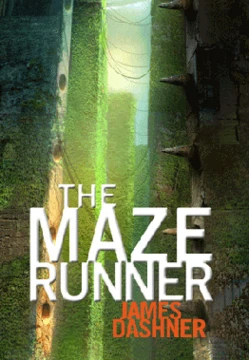
The Glade
A green pocket of safety wrapped in a labyrinth that rewrites itself every night.

The Glade is the enclosed valley at the heart of James Dashner's *The Maze Runner* saga. A stretch of green grass, a shallow stream, and a scattering of trees, it is ringed on every side by the towering, shifting walls of the Maze. For the group of amnesiac teenagers known as the Runners, the Glade is simultaneously a home, a prison, and the last known safe place in a world they cannot remember leaving.
Its role in the trilogy is foundational: it is where the Runners establish their social order, where Thomas arrives and disrupts the fragile balance, and where the first cracks in their understanding of WCKD's experiment begin to show. By the time the story moves into *The Scorch* and *The Death Cure*, the Glade is left behind—its safety an illusion that was never meant to last.
- Type
- Enclosed valley / clearing
- Surroundings
- The Maze (shifting walls)
- Inhabitants
- The Runners (Thomas, Newt, Minho, Alby, and others)
- Key structure
- A large door set into the far wall, opening periodically for new arrivals
- Primary threat
- The Maze, which reconfigures its passages every night
- First appears
- The Maze Runner (Book 1 / Film 1)
- Fate
- Abandoned as the Runners push beyond the Maze into the Scorch
Lore & Background
The Glade exists as a contained ecosystem within the Maze's outer boundary. A stream bisects the clearing, feeding a small patch of cultivated ground where the Runners grow what they can. The rest of the space is a patchwork of improvised shelter: log shelters, stacked crates, a jury-rigged generator that throws a dim amber glow over the camp at night, and the ever-present smell of woodsmoke and wet earth. The far wall—smooth, featureless except for a massive metal door—is the only point of contact with the outside. When that door groans open, a new boy steps in, and the Runners must decide whether to welcome him or let the Maze take him.
Socially, the Glade operates on a strict division of labor. Cooks tend the food stores, Builders maintain the shelters, Mechanics keep the generator and any salvaged technology running, and the Runners themselves scout the Maze's passages on the rare days the walls hold still. Minho, as leader, enforces the rules with a pragmatism that borders on cruelty, because in a place where the walls can swallow a person whole, hesitation is death. The Glade's culture is one of survival stripped of sentiment: you eat, you work, you map, and you do not question the door.
What the Glade truly represents, in the broader WCKD experiment, is a controlled variable. The Runners are not simply surviving; they are being observed, tested, and measured. The Glade's apparent safety is a leash, and the Maze beyond the wall is the arena. When Thomas's arrival triggers a cascade of memories and the Maze's rules begin to unravel, the Glade stops being a refuge and becomes the first room in a much larger test.
In Their Own Story
The generator coughs and dies again, and the Glade plunges into a darkness so total the stream becomes a sound rather than a sight. Thomas presses his back against the cold stone of the far wall, feeling the faint vibration of the door's locking mechanism still humming in the metal. Around him, the others huddle in their log shelters, breathing hard, listening. The Maze is shifting. He can hear it—the deep, grinding groan of walls sliding against walls, a sound like the earth clearing its throat. Newt grips his shoulder. "Don't go out tonight," he whispers, and the words carry the weight of every night before, when someone had gone out and not come back. Thomas looks at the black expanse beyond the stream, where the first stretch of wall disappears into the dark, and for a moment the Glade feels less like a home and more like a cage with the bars slowly tightening. The generator sputters back to life. Amber light floods the grass. The walls stop moving. Nobody breathes. Nobody moves. And the Glade, for one more night, holds.
Reader's Guide
The Glade is a long, narrow valley, perhaps a few hundred meters across, carpeted in short grass and dotted with scrubby trees. A shallow, cold stream cuts through the center, its banks worn smooth by the Runners' constant traffic. The far end is sealed by a sheer stone wall, and set into that wall is a massive metal door—rusted, heavy, the only aperture in the entire perimeter. The near end and both flanks are open to the Maze: towering passages of pale, featureless wall that stretch up beyond sight, their geometry shifting every night so that no map drawn by day is valid by morning.
Inside the clearing, the Runners have built a rough settlement. Log shelters with tarped roofs cluster near the stream. A pile of salvaged crates and metal sheets serves as the Builders' workshop. A small generator, kept running by the Mechanics, throws a warm, flickering light that makes the whole camp look like a stage set. The air smells of woodsmoke, damp soil, and the faint metallic tang of the generator's exhaust. At night, the temperature drops sharply, and the only sound is the stream and the distant, subsonic groan of the Maze rearranging itself.
The rules are simple and absolute: stay within the Glade's bounds, follow the job assignments, and never, under any circumstances, enter the Maze after dark. The door opens on a schedule the Runners have never fully decoded, and when it does, a new arrival is brought in. The Glade is safe—so long as the walls hold, the generator runs, and no one dares to push past the first bend in the passage. In the sequel, that safety evaporates. The Maze is breached, the Glade is no longer a refuge, and the Runners must push outward into the Scorch, a blasted, irradiated wasteland where the rules they knew no longer apply. By the third installment, the Glade is a memory, a green smear in the periphery of a much larger, much deadlier world.
Did You Know?
- The Glade's only point of entry and exit is the massive door in the far wall, which opens on a periodic schedule to admit a new boy—making the Runners' population a rolling, unpredictable quantity.
- The Maze's walls shift their configuration every single night, which is why the Runners' maps are useless after dark and why the Glade, as a fixed space, is their only reliable reference point.
- The Runners maintain a strict job-based hierarchy within the Glade—Cooks, Builders, Mechanics, and Runners—reflecting a society that must function efficiently in a space with zero external supply.
- In the broader WCKD experiment, the Glade functions as a controlled environment: the Runners are not simply surviving but being observed, and the Glade's apparent safety is part of the test design.
More in World & Settings
Elsewhere in the The Maze Runner universe
Spotted an error? Know more?
This is a living reference — every entry is fact-audited, and reader corrections feed straight into our audit queue. Suggest an edit · See this site's audit record