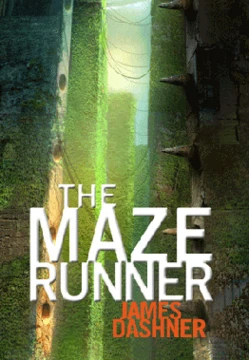
The City of Glass
Behind glass walls, the cure is a cage and the truth is the only key that shatters it.

The City of Glass is the third and final installment in James Dashner's Maze Runner trilogy, serving as the climactic destination where the surviving Runners finally confront the full scope of WICKED's experiment. After escaping the Glade, surviving the Maze, and crossing the devastated wasteland of the Scorch, the group arrives at a sealed metropolis enclosed in towering walls of glass—only to discover that the 'cure' for the Flare they were promised is something far more sinister than salvation.
The book functions as both resolution and reckoning: every mystery planted across the first two novels converges here, forcing the characters to choose between a comfortable lie and a dangerous truth that could reshape the entire post-Flare world.
- Series position
- Third and final book in the Maze Runner trilogy
- Setting
- A sealed city enclosed by walls of glass, housing 'cured' Flare survivors
- Antagonist
- WICKED, the clandestine organization behind the Flare and the Maze experiments
- Central revelation
- The administered 'cure' is a different pathogen designed to suppress and control, not heal
- Core cast
- Thomas, Teresa, Newt, Minho, Brenda, Vick, and the surviving Runners
- Tone
- Dystopian thriller with a shift from survival-horror to conspiracy-exposé
Lore & Background
The City of Glass is not a natural settlement but a constructed containment zone. WICKED built it to house the population they had already administered their so-called cure to, keeping them in a sealed, monitored environment where the second pathogen could do its quiet work. The glass walls serve a dual purpose: they project an image of safety and transparency to the outside world while functioning as an impenetrable barrier that prevents anyone from leaving or anyone new from entering. Inside, daily life appears orderly—people work, socialize, and believe they are survivors of a global plague. In reality, they are subjects in a long-term behavioral experiment, their aggression and independent thought dulled by the replacement virus.
The Runners' arrival disrupts this carefully maintained equilibrium. Thomas, still carrying the fragmented memory of the Maze and the Scorch, refuses to accept the city's narrative at face value. Teresa, whose knowledge of WICKED's internal workings makes her both a target and a key, becomes the linchpin of the group's investigation. Together they peel back layers of institutional control, discovering that the Flare was never a natural disaster but a manufactured event, and that the 'cure' is a second, subtler weapon—one that renders its hosts docile and obedient rather than healthy.
The city's architecture reinforces its thematic role: everything is visible, everything is contained, and nothing is what it seems. The glass that should symbolize openness instead functions as a one-way mirror. The Runners must decide whether to break the walls and let the outside world face the truth, even if that truth means chaos, or to preserve the fragile peace of a population that would rather not know.
In Their Own Story
The first thing Thomas notices is the silence. Not the howling, ash-choked quiet of the Scorch, but a curated stillness—air filtered, light diffused through panes of glass that stretch from floor to sky on every side. The city hums with a low, almost musical vibration, as though the walls themselves are breathing. Newt presses his palm flat against the nearest panel and stares at the faint greenish glow threading through the glass like veins beneath skin. Minho says nothing. He's been quiet since they crossed the perimeter, his jaw working, his eyes cataloguing every exit, every watchtower, every face that turns to look at them with an expression of polite, rehearsed welcome. A woman in a clean white coat steps forward, smiles, and says the word 'cure' the way you'd say 'home.' Thomas feels the word land in his chest like a stone dropped into still water. He looks at Teresa. She's already looking at the glass. At the way the light bends. At the way it doesn't, quite, let you see through to the other side.
Reader's Guide
The group stumbles out of the Scorch and into the city's outer perimeter, exhausted and half-dead. WICKED's personnel receive them with a script: you are safe, you are cured, stay. Thomas resists. Teresa, whose memories of WICKED's inner workings are surfacing in fragments, pushes the group to investigate rather than settle. The stakes are immediate—distrust gets you separated, questioned, possibly 're-cured'—but the group holds together, driven by the shared memory of the Maze and the Scorch that no amount of filtered air can erase.
The investigation deepens. Brenda and Vick work the city's infrastructure, finding discrepancies in medical records and supply logs. Minho and Newt map the glass walls, discovering that the city is smaller than it appears, that the 'outside' the citizens see is a projection. Teresa deciphers WICKED's true objective: the Flare was engineered, and the replacement pathogen is a behavioral suppressant. The group fractures under the pressure—some want to flee, some want to fight, some want to protect the citizens who don't yet know they're being controlled.
The climax forces a choice. Thomas and the core group breach the city's systems to broadcast the truth to the outside world, releasing the original Flare strain as a viable vaccine while exposing the 'cure' as a weapon. The glass walls shatter—not with an explosion but with the weight of a population choosing to see. The city's careful order collapses into chaos, but it is a living, breathing, dangerous freedom. The Runners walk out into a world that is broken, uncertain, and finally theirs to rebuild.
Did You Know?
- The City of Glass inverts the Maze's central metaphor: where the Maze was a puzzle to be solved from the inside, the city is a cage whose bars are made of transparency, making the illusion of openness the true trap.
- Teresa's role shifts dramatically across the trilogy—from a passive figure in the Glade to the group's primary intelligence source in the City of Glass, where her partial knowledge of WICKED's protocols becomes the key t
- The 'cure' that WICKED administers is not a treatment at all but a second pathogen, meaning the citizens of the city are not healed survivors but a new generation of subjects, making the city a closed loop of manufacture
- The glass walls function as a narrative device: they let the reader see the city's interior clearly while simultaneously blocking the characters' exit, mirroring how WICKED's information is always almost accessible but n
More in Story & Timeline
Elsewhere in the The Maze Runner universe
Spotted an error? Know more?
This is a living reference — every entry is fact-audited, and reader corrections feed straight into our audit queue. Suggest an edit · See this site's audit record